Choosing a fertilizer and a hand transplanter in Pune requires more than picking the highest N-P-K number or the most comfortable-looking handle. You will be able to match fertilizer to soil, season, and plant age; inspect a PVC-handle transplanter; and follow a transplanting workflow that protects disturbed roots.
Key takeaways
- Start with a soil test or Government of India Soil Health Card.
- Compare N-P-K, secondary nutrients, micronutrients, and soluble salt risk.
- Water dry soil before fertilizing to reduce root burn.
- Match transplanter blade size and handle grip to the planting job.
How to Choose Fertilizer by Nutrient Analysis and Garden Use
Begin with a soil test, not a familiar bag colour or the highest N-P-K number. Pune’s red or black soil, irrigation water, imported potting media, compost history and container production can produce different pH, salinity and nutrient levels. A Government of India Soil Health Card gives a useful starting recommendation.
| Situation | Suitable choice | Practical direction |
|---|---|---|
| Seedlings | Mild, soluble balanced NPK | Use dilute feed; avoid concentrated urea |
| Balcony pots | Water-soluble 20-20-20 | Apply only to moist media |
| Vegetables and monsoon beds | Granular NPK based on the test | Keep soluble nitrogen away from heavy rain |
| Lawns | Nitrogen-led granular fertiliser | Choose the analysis after checking soil fertility |
| Shrubs and ornamentals | Compost plus balanced or low-nitrogen NPK | Feed established root zones, not stems |
Read 10-10-10 as 10% nitrogen, 10% phosphate expressed as P₂O₅, and 10% potash expressed as K₂O. A 50 kg bag of 18-46-0 DAP contains 9 kg N and 23 kg P₂O₅, not 23 kg elemental phosphorus. A high number is not automatically better.
Use compost, vermicompost or farmyard manure to improve organic matter, but test mature material before heavy use. Urea supplies nitrogen, single super phosphate supplies phosphorus, muriate of potash supplies potassium, and micronutrient mixes address confirmed deficiencies.
For soluble feed, calculate grams per litre as desired ppm ÷ (10 × nutrient percentage). Thus, 100 ppm nitrogen from a 20% N product requires 5 g/L. Fertilizers for garden plants in Pune should be specified separately from a PVC-handle transplanter: one is a regulated input, the other a hand tool.
When and How to Fertilize Pune Gardens Without Causing Burn
A yellow leaf is not proof of nitrogen deficiency. Check new and old leaves, pests, root damage, drainage, and recent repotting before feeding; excess water and salt buildup can produce similar symptoms. For Pune containers, a soil or growing-media test is more reliable than a calendar.
A Soil Health Card report can show pH, salinity, phosphorus, potassium, and micronutrient status.
1. Match the material to the need. Compost, vermicompost, and farmyard manure improve organic matter but release nutrients slowly. Granular NPK, urea, single super phosphate, and muriate of potash provide specific nutrients; use micronutrient mixes only for a confirmed deficiency or label direction.
On Indian labels, N-P-K means nitrogen, P₂O₅, and K₂O, not elemental phosphorus and potassium.
2. Measure, never estimate by handful. Weigh granular fertilizer and follow the label rate for the pot volume or bed area. Scatter it on moist soil, keep it away from stems and exposed roots, lightly incorporate it, and water thoroughly.
3. Mix soluble fertilizer from nutrient concentration. Use grams per litre = desired ppm ÷ (10 × nutrient percentage). Thus, 100 ppm nitrogen from a 20% nitrogen product requires 5 g/L. Apply to already-moist media, not drought-dry soil.
4. Feed actively growing plants after watering. Reduce or pause soluble nitrogen before heavy monsoon rain, because runoff and leaching move it below roots. During hot, dry summer, water first and feed lightly; resume a measured schedule after growth returns.
Stop after leaf-edge browning or crusty white salts appear, flush pots with clean water, and retest.
Choosing and Using the Right Transplanter for Containers and Beds
Choose a transplanter by blade geometry, not by handle colour. A narrow, pointed blade makes small holes and lifts plugs with limited root disturbance; a broad, cupped blade removes more soil and suits larger root balls but wastes space in closely planted trays.
| Blade choice | Best use | Main drawback |
|---|---|---|
| Narrow, pointed | Seedlings, plugs, small containers | Cannot move much soil |
| Broad, cupped | Larger root balls and bed planting | Disturbs nearby roots |
| Dibber | Holes in loose, prepared media | Does not lift or move a plug |
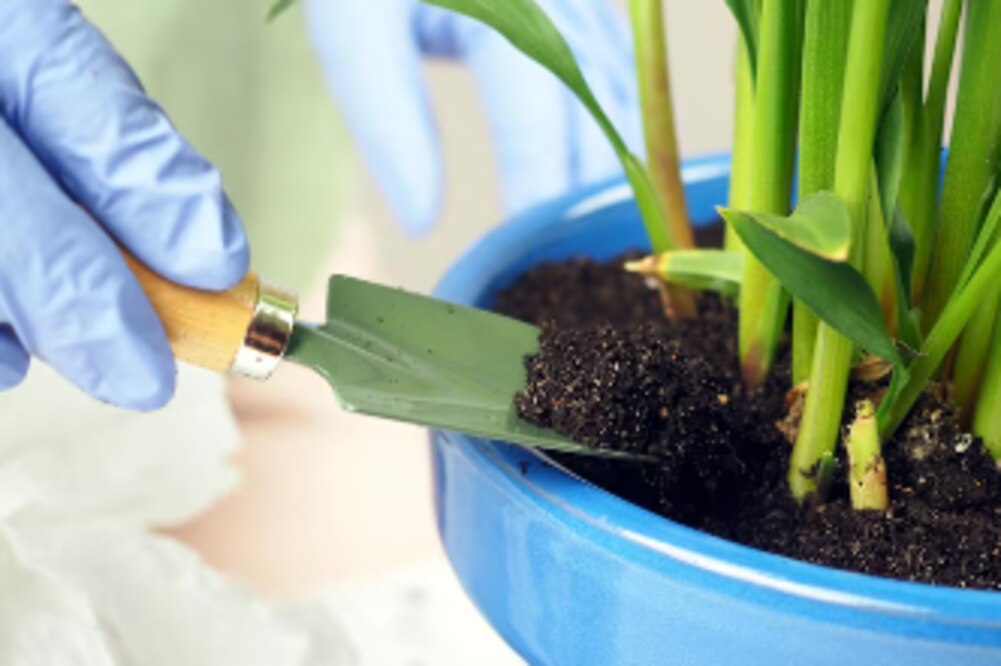
For a PVC-handle transplanter in Pune, inspect the tool as two separate parts. Check blade material and thickness, a symmetrical edge, a tight socket or ferrule, a rigid shank, and a grip without cracks.
PVC provides a washable grip, but ultraviolet exposure, impact, and incompatible solvents can make it brittle; a loose ferrule often fails before the blade wears out.
Use the tool in this order:
- Water the seedling a few hours before transplanting so the root ball holds together.
- Make a hole slightly wider and deeper than the roots; do not force the blade through a compacted root mass.
- Lift from beneath the plug, supporting the leaves or root ball rather than pulling the stem.
- Set the seedling at its original soil depth, firm media gently, and water around the roots.
Buy planting hand tools in Pune by task, not as identical sets. A trowel moves more soil, a cultivator breaks surface crust, and a transplanter handles narrow holes and small plugs.
How to Inspect and Source Fertilizers and Hand Tools in Pune
A search for “fertilizers pvc handle transplanter in Pune” combines two procurement categories. Request separate quotations, invoices, delivery dates, and quality checks for the fertilizer and the hand tool.
1. For fertilizer, request a legible label showing the product name, N-P-K analysis, net weight, manufacturer, batch or lot number, and manufacturing date. Check that the seller’s invoice identifies the grade and complies with India’s Fertiliser Control Order, 1985.
2. Match the quotation to the material ordered: compost, vermicompost, farmyard manure, granular NPK, water-soluble NPK, urea, single super phosphate, muriate of potash, or a micronutrient mix. Do not accept “plant food” without an analysis; a higher N-P-K number is not automatically better.
3. For a pvc handle transplanter in pune, specify blade length, width, point shape, material, and thickness. A narrow pointed blade suits plugs and small planting holes; a broad cupped blade removes more soil. PVC colour does not prove stainless steel or corrosion resistance.
4. Inspect the blade edge for symmetry, then twist the handle and shank. Reject a tool with a loose ferrule, cracked grip, thin bending blade, or movement under light levering force; ultraviolet exposure and solvents can make PVC brittle.
5. Ask New Garden Guru Farms & Nursery to quote each fertilizer and tool separately, with batch details and dimensions recorded.
Schedule soluble-nitrogen purchases around irrigation capacity, not heavy pre-monsoon or monsoon rain, which can move nutrients below roots or into runoff.
Storage, Maintenance, and the Fertilizer–Transplanting Workflow
Keep fertilizer sealed in its labelled original bag, on a raised shelf in a cool, dry, ventilated room. Moisture cakes urea, NPK granules, and micronutrient mixes, making each scoop deliver an uneven dose. Store compost, vermicompost, and farmyard manure covered but breathable, away from seed, pesticides, and drains.
Treat “fertilizers pvc handle transplanter in pune” as two procurement lines, not one kit. Buy planting hand tools in pune by task, then keep tools in a separate dry rack; wet fertilizer dust can accelerate corrosion on carbon-steel blades and ferrules.
- Check the fertilizer label, grade, batch details, and instructions before opening. Do not transfer it to an unlabelled container.
- Inspect the transplanter before work. Confirm a straight, symmetrical blade, secure ferrule, rigid shank, uncracked PVC grip, and no looseness under hand pressure.
- Transplant into prepared, moist soil. Keep granular fertilizer out of the planting hole and away from tender roots; concentrated salts can scorch them.
- Water the root zone after planting. Apply the measured fertilizer around the plant, not against the stem, and use a diluted water-soluble feed only at its label rate.
- Clean soil from the blade, wash off fertilizer residue, dry the tool completely, and wipe exposed carbon steel with a thin oil film.
Wait until new growth shows before routine feeding of a stressed transplant. Replace any tool with a split handle or loose ferrule rather than levering harder.
Frequently asked questions
How should you choose fertilizer for a Pune garden?
Start with a soil test or Soil Health Card, then compare the fertilizer’s N-P-K analysis with your crop, soil pH, compost history, and container media. Check for secondary nutrients and micronutrients when the test identifies a deficiency.
How can you prevent fertilizer burn in Pune gardens?
Measure the product instead of applying by colour or guesswork, keep granules away from stems, and water dry soil before application. Follow the label rate and reduce applications when irrigation water or potting media already has high salt levels.
What should you look for in a PVC-handle transplanter?
Choose a blade width and depth that fit the pot or planting bed, with a firmly joined blade, smooth edges, and a PVC handle that provides a secure grip. Use a narrower blade around established roots and a wider blade for open beds.
How should fertilizers and planting hand tools be stored?
Keep fertilizer sealed, dry, and off the floor, away from seed, animal feed, and pesticides. Clean soil from the transplanter after use, dry the blade, inspect the handle and joint, and store the tool under cover.